CJCR Publishes Volume 27, Issue 1 (Fall 2025)
The first of three issues is now available online and in print edition.
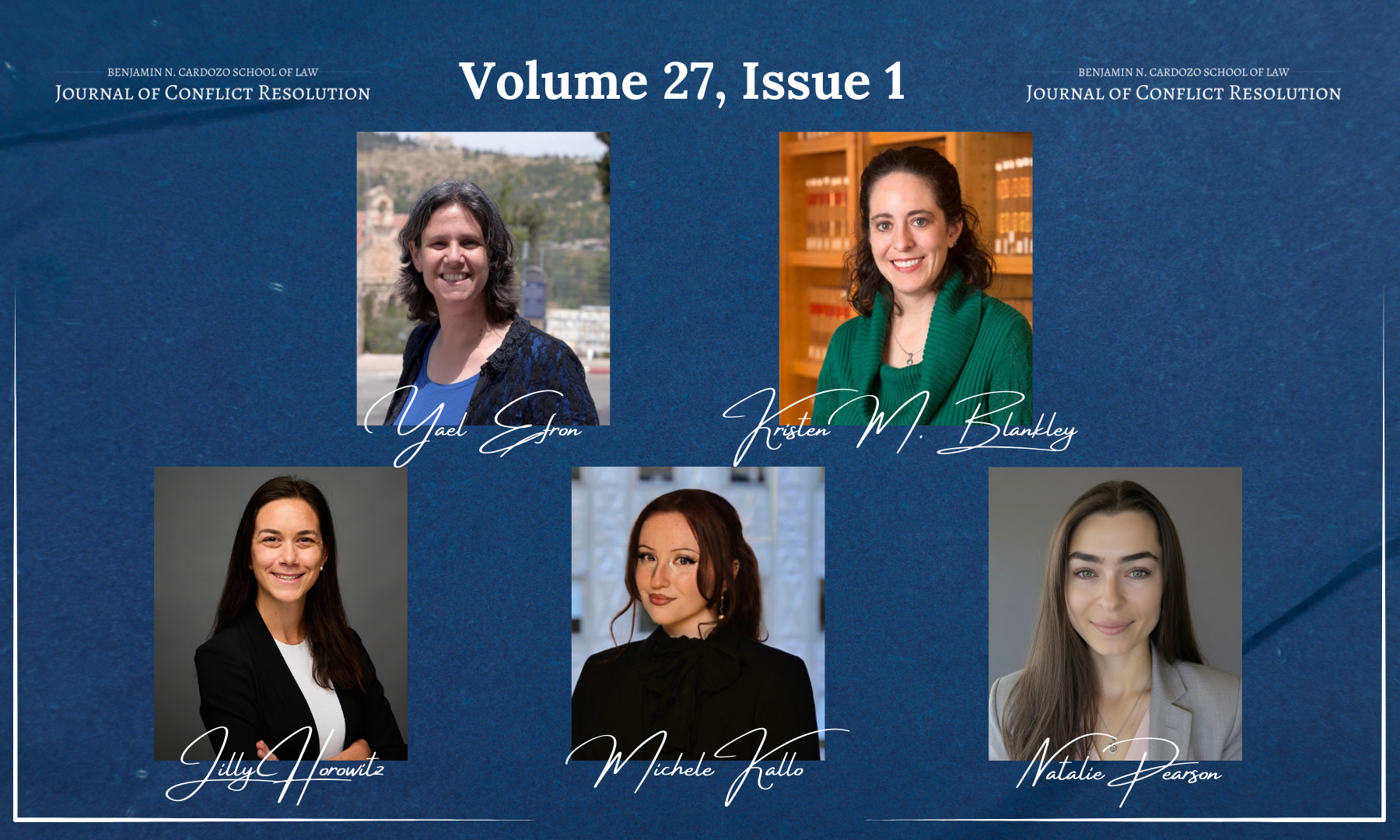
Top row, left to right: Yael Efron and Kristen M. Blankley
Bottom row, left to right: Jilly Horowitz, Michele Kallo, and Natalie Pearson
The Cardozo Journal of Conflict Resolution—the country’s preeminent legal journal of arbitration, negotiation, mediation, settlement, and restorative justice—today published the web edition of Volume 27, Issue 1 (Fall 2025). The print edition of the issue has also been released.
Accessible at Volume 27.1: Fall 2025, this issue contains a transcript from the Twenty-Fourth Annual International Advocate for Peace Award, Honoring Dr. Zafra M. Lerman; a transcript from the United States Court of Appeals for the Second Circuit; Articles by Yael Efron and Kristen M. Blankley; and Notes by Jilly Horowitz, Michele Kallo, and Natalie Pearson.
On December 17, 2024, the United States Court of Appeals for the Second Circuit's Civil Appeals Mediation Program held its 2024 Mediation Colloquy, titled: "50 Years of Building Bridges Through Appellate Mediation". The Journal is honored to publish a transcript of the Mediation Colloquy, which featured U.S. Supreme Court Justice Sonia Sotomayor, Chief Judge Debra Livingston, Circuit Judge Ray Lohier, and Chief Circuit Mediator Kathleen M. Scanlon.
On March 6, 2025, the Journal honored Dr. Zafra M. Lerman, renowned chemist, educator, and humanitarian, at the Twenty-Fourth Annual International Advocate for Peace Award. Dr. Lerman is the President of the Malta Conferences Foundation, and in addition to her leadership in science diplomacy, she served as chair of the American Chemical Society's Subcommittee on Scientific Freedom and Human Rights and vice chair for chemistry on the board of the Committee of Concerned Scientists. She has worked on human rights cases across the globe, including in the former Soviet Union, China, and Guatemala, and received the Presidential Award for Excellence in Science, Mathematics, and Engineering Mentoring from President Clinton. In her work bringing together scientists from hostile nations, Dr. Lerman continues to use the common language of science to bridge chasms of distrust and intolerance.
Dr. Yael Efron is an LL.D. graduate from the Faculty of Law at Hebrew University, Jerusalem and serves as Vice President for Teaching in Research and Head of the Crisis and Emergency Management Program at Ramat-Gan Academic College. Dr. Efron is a visiting professor at Mitchell-Hamline School of Law in Minnesota; University of Missouri LL.M. program in dispute resolution; Osgoode Professional Development program at York University, Canada; and Tunghai University International College, Taiwan. She was a visiting scholar at Masaryk University Law Faculty in Czechia under the auspices of the Theodore Herzl Distinguished Chair. Dr. Efron is the recipient of the Halbert Centre for Canadian Studies Post-Doctoral Fellowship and of the Theodore Herzl Distinguished Chair Award. She teaches Negotiation, Alternative Dispute Resolution, Legal Foundations, Civil Procedure and Family law, and published widely on legal education, pedagogy and curriculum design, negotiation, dispute resolution and other subjects.
Professor Kristen Blankley teaches and researches in the areas of alternative dispute resolution, particularly mediation and arbitration issues. She joined the faculty of the University of Nebraska College of Law in 2010 and is currently the Henry M. Grether, Jr. Professor of Law. Professor Blankley is interested in the intersection of ADR and ethics, both ADR ethics and legal ethics. She has written on topics including mediation, family mediation, arbitration, collaborative law, ombuds processes, and access to justice. More information about Professor Blankley can be found at https://law.unl.edu/kristen-blankley/.
Jilly Horowitz is a third-year law student at Cardozo School of Law. Jilly currently serves as Editor-in-Chief for Volume 27 of the Cardozo Journal of Conflict Resolution. Her Note "Pursuing Restorative Justice for the Legacy of Federal Indian Boarding Schools" explores the history of the United States' federal Indian boarding school policy through the government's efforts to reckon with its effects from 2021–2024. The Note proposes restorative justice as an appropriate framework to remedy the complex and widespread harms that Native individuals and communities continue to experience. The Note concludes with a discussion of how Congress could structure a law to enable the federal government to engage in meaningful restorative efforts guided by those who have endured the harm, as restorative justice requires.
Michele Kallo is a third-year law student at Benjamin N. Cardozo School of Law. Michele currently serves as Executive Editor for Volume 27 of the Cardozo Journal of Conflict Resolution. Her Note, “Dispute Resolution Tailored for Digital Assets,” examines how traditional litigation and decentralized arbitration fail to adequately address the nuances of the digital asset market due to high costs, jurisdictional complexities, and reliability concerns. The Note proposes that the International Chamber of Commerce create a hybrid arbitration framework that preserves party anonymity and enables on-chain enforcement while maintaining the procedural safeguards of institutional arbitration.
Natalie Pearson is a third-year law student at Cardozo School of Law. Natalie currently serves as Senior Note Editor for Volume 27 of the Cardozo Journal of Conflict Resolution. Her Note, “Blazing a New Path: How Regulatory Negotiation Can Resolve Cannabis Legalization’s Shortcomings,” examines how New York’s cannabis legalization has faltered under regulatory inefficiencies, financial barriers, and inconsistent enforcement. The Note proposes adopting regulatory negotiation as a collaborative framework for developing enforceable, consensus-based rules that stabilize and strengthen New York’s cannabis market.
The Executive Board of the Journal would like to extend its deepest gratitude to each and every Staff Editor and Editorial Board member who worked so diligently on editing the Articles and Notes for this issue.
