CJCR Publishes Volume 27, Issue 2 (Symposium 2025)
The second of three issues is now available online and in print edition.
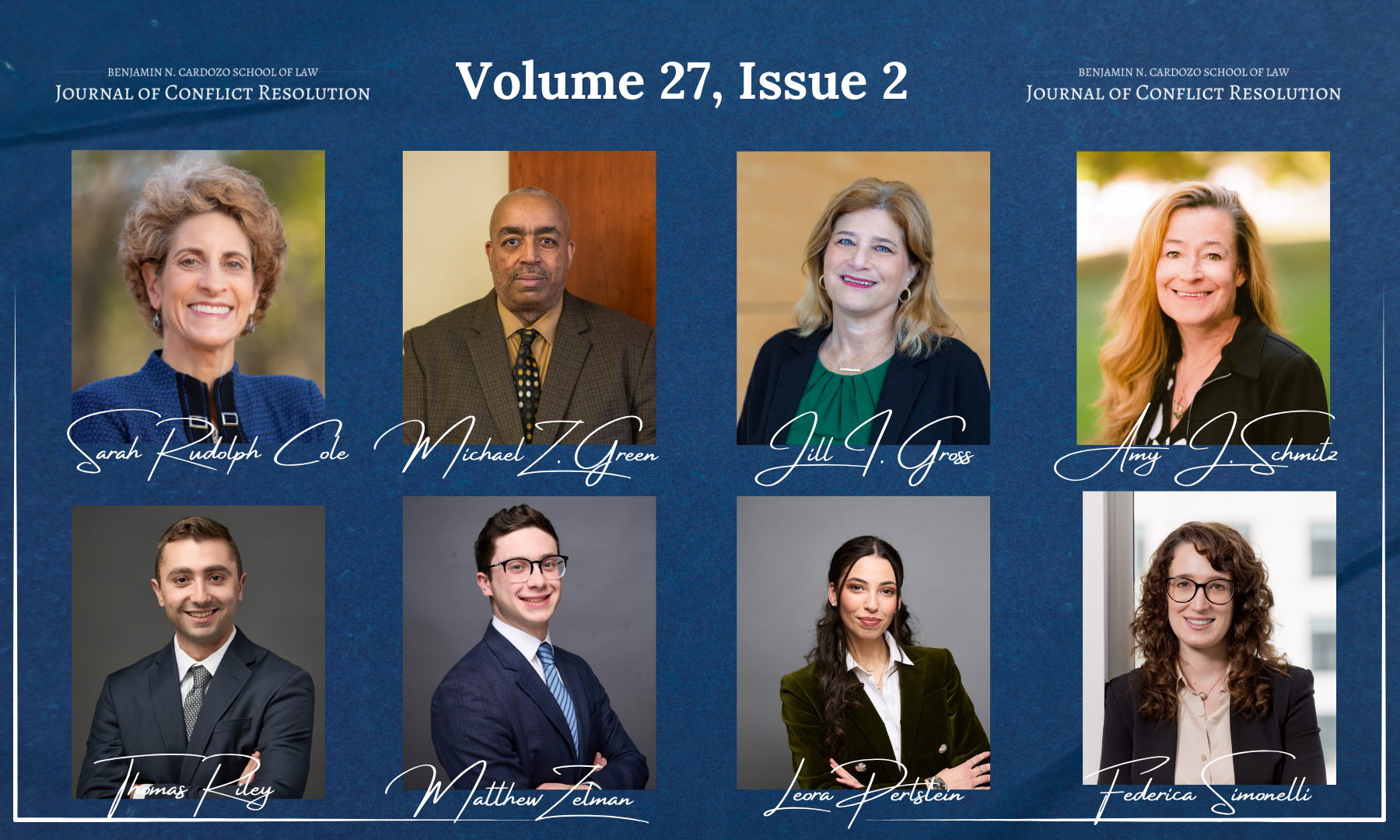
Top row, left to right: Sarah Rudolph Cole, Michael Z. Green, Jill I. Gross, and Amy J. Schmitz
Bottom row, left to right: Thomas Riley, Matthew Zelman, Leora Perlstein, and Federica Simonelli
The Cardozo Journal of Conflict Resolution—the country’s preeminent legal journal of arbitration, negotiation, mediation, settlement, and restorative justice—today published the web edition of Volume 27, Issue 2 (Symposium 2025). The print edition of the issue has also been released.
Accessible at Volume 27.2: Symposium 2025, this issue contains Articles by Sarah Rudolph Cole, Michael Z. Green, Jill I. Gross, and Amy J. Schmitz; Notes by Thomas Riley, Matthew Zelman, and Leora Perlstein; and a Commentary by Federica Simonelli.
Sarah Rudolph Cole is the Michael E. Moritz Chair in Alternative Dispute Resolution at the Moritz College of Law at The Ohio State University. Professor Cole was the Director of the Moritz Program on Dispute Resolution for over 15 years and the co-author of Dispute Resolution: Negotiation, Mediation and Other Processes (7th ed.) and Mediation: Law, Policy and Practice (3d ed.). In 2013, she received the Ohio State Alumni Award for Distinguished Teaching and in 2024, won the University of Puget Sound’s Distinguished Alumni Award for Lifetime Professional Achievement. In 2022, Professor Cole won CPR’s Outstanding Professional Article Award in the field of ADR for her article Arbitrator Diversity: Can It Be Achieved? and, along with her co-editors, Art Hinshaw and Andrea Schneider, won the CPR Outstanding Book Award in the field of ADR for 2022 for Discussions in Dispute Resolution: The Foundational Articles. In 2024, she was named Scholar-in-Residence for the International Association of Mediators for 2025-27. In 2025, she was inducted into the National Academy of Arbitrators. In 2026, she won CPR’s Outstanding Book Award in the field of ADR a second time for Discussions in Dispute Resolution: The Next Generation (2000-2009), along with co-editors Hinshaw and Schneider. Professor Cole is also a contributor to Indisputably, the alternative dispute resolution law professors’ blog.
Michael Z. Green is a member of the Texas A&M University School of Law’s tenured faculty, where he serves as Director of the Workplace Law Program and holds the current title of Dean’s Research Scholar for 2025-27. His extensive scholarship focuses on workplace disputes and the intersection of race and alternatives to the court resolution process. An award-winning author, Professor Green recently received the CPR Award for an Outstanding Article and was selected as the prestigious Schwartz Lecturer by the Ohio State Journal on Dispute Resolution.
Professor Green is also a member of the National Academy of Arbitrators. In his capacity as a labor and employment arbitrator, he serves as a member of the American Arbitration Association’s National Labor Arbitration panel, the Federal Mediation and Conciliation Service Labor Panel, the Dallas Area Rapid Transit Trial Board, the City of Fort Worth Police Arbitration Hearing Officer Panel, the City of Chicago Board of Education Hearing Officer Panel, and the City of Houston Police Arbitration Hearing Officer Panel. His legal practice experience in Chicago, Illinois and Louisville, Kentucky, while at prominent law firms, focused on representing clients in workplace labor, employment, and employment discrimination law disputes.
Professor Green has been invited to discuss his scholarly endeavors at scores of venues throughout the nation and internationally. He also served as a visiting professor at the Chicago-Kent College of Law in Spring 2021, where he taught Employment Law, at the University of Georgia School of Law in Spring 2013, where he taught Employment Discrimination and Employment Law, and at Florida State University College of Law, where he taught Evidence and Employment Discrimination in Spring 2008. Professor Green is a co-author on the Fourth Edition of ADR in the Workplace, published by West in 2020, Labor Law in a Nutshell, published by West in 2022, and Gilbert’s Law Summaries on Labor Law, published in 2022.
Professor Green is an elected Fellow to the College of Labor and Employment Lawyers and a member of the American Law Institute. He received the 2015 Paul Steven Miller Memorial Award at the Tenth Annual Colloquium on Scholarship in Employment and Labor Law, given to a scholar demonstrating outstanding academic and public contributions in the field of labor and employment law. A former Secretary of the ABA’s Labor and Employment Section, Professor Green holds an LL.M. from the University of Wisconsin School of Law, a J.D., cum laude, and an M.S. in Human Resources and Industrial and Labor Relations, both from Loyola Chicago, and a B.S. in Electrical Engineering from the University of Southern California.
More biographical information is available at: https://www.law.tamu.edu/faculty/faculty-profiles/michael-z-green.html.
Jill I. Gross is a Vice Dean for Academic Affairs and Professor of Law at the Elisabeth Haub School of Law at Pace University, and teaches ADR, securities law, and professional responsibility. She is co-editor of the book, The Federal Arbitration Act: Successes, Failures, and a Roadmap for Reform (Cambridge University Press 2024), and co-author of the treatise Broker-Dealer Law and Regulation and the casebook Arbitration: Law Policy, and Practice. She has published dozens of book chapters and articles on the negotiation, mediation and arbitration of commercial and securities disputes. She has chaired the AALS Section on Alternative Dispute Resolution, and is an arbitrator for the American Arbitration Association and FINRA. She also has taught at Cornell Law School, UNLV’s Boyd School of Law and Benjamin N. Cardozo School of Law. She received an A.B. magna cum laude, Phi Beta Kappa, from Cornell University and a J.D. cum laude from Harvard Law School.
Amy J. Schmitz is a full professor at The Ohio State Moritz College of Law and Program on Dispute Resolution as the John Deaver Drinko-Baker & Hostetler Endowed Chair in Law and Director of JusticeTech. She is also affiliated with the Program on Data Governance and the Divided Community Project. Before teaching at Ohio State, Professor Schmitz taught at the University of Missouri School of Law and Center for Dispute Resolution as the Elwood L. Thomas Missouri Endowed Professor of Law, starting in 2016. Previously, she was a Professor at the University of Colorado School of Law for over 16 years. Prior to teaching, she practiced law in Seattle and Minneapolis and served as a law clerk for the U. S. Court of Appeals for the 8th Circuit.
Professor Schmitz teaches courses in Law and Technology/JusticeTech, Contracts, Lawyering and Problem-Solving, Online Dispute Resolution (ODR), Arbitration, International Arbitration, Social Media and Conflict, and the Uniform Commercial Code. She has been heavily involved in Arbitration and LegalTech teaching and research for a long time, is a Fellow of the National Center for Technology and Dispute Resolution, serves on the AAA-ICDR Education Committee and the AI Ambassadors Program, is on the Board of Directors for the International Council on ODR, and the Editorial Board for the International Arbitration peer-reviewed Journal. She was the long-time Co-Chair of the ABA Technology Committee of the Dispute Resolution Section, and now serves on its Beyond the Page Task Force. An elected member of the American Law Institute, she won the 2023 Association of American Law Schools Technology, Law and Legal Education Section Award and the 2025 ABA Section on Dispute Resolution Scholarly Achievement Award.
Professor Schmitz has delivered over 185 presentations and hosts The Arbitration Conversation, a highly regarded webcast (100 episodes on UTube) that moved to a podcast (17 episodes and more coming). She also is a researcher with the ACT Project exploring AI and dispute resolution at the Cyberjustice Laboratory in Montreal, Canada, and is heavily involved in discussions and research around technology, dispute resolution, and access to justice. She has published over 90 articles and co-authored several leading books on dispute resolution and arbitration. She has received the Inst. for Conflict Prevention and Resolution (CPR) Award for one of her articles as well as the CPR Book Award in 2023 and again in 2025. Amy has been an Expert Consultant on two USAID Projects, two Fulbright Specialist grants, and does research, teaching and presentations throughout the world.
See more at: Amy Schmitz | Moritz College of Law (osu.edu).
Thomas Riley is a recent graduate from Cardozo School of Law and served as a Staff Editor for Volume 26. His note, "How to Beat the NFL's Best Defense: Attacking the Mass Arbitration Phenomenon with Class Arbitration" offers a critique of current mass arbitration procedures in light of current unscrupulous business practices. In the wake of the NFL's decision to institute class action waivers within their mandatory arbitration agreements, the Note chronicles how the law got here, the problems these clauses pose to plaintiffs, and potential solutions. Specifically, his Note argues that corporate reliance on class-waiver arbitration—exemplified by the NFL’s post–Sunday Ticket maneuvering—contradicts neobrandesian antitrust enforcement, replaced judicial accountability with economically impractical bilateral claims, and produced the perverse mass-arbitration “reverse default judgment” trap of the defendants’ own design. It contends a coherent fix is a return to class arbitration, reinforced by structural incentives like safe-harbor provisions, to realign efficiency, fairness, and the FAA’s original purpose before arbitration finishes eating the courthouse whole.
Additionally, Thomas currently practices law in New York City and specializes in products liability, wrongful death, mass tort, and sexual harassment litigation. His time at Cardozo—specifically writing and editing for the Cardozo Journal of Conflict Resolution—grounded his understanding of consumer protection issues and nefarious corporate litigation practices.
Matthew Zelman is a third-year law student at Cardozo School of Law and currently serves as a Blog Editor for Volume 27. His Note, "A Comparative Study of the U.S. and Foreign Tipping Culture and How Collective Bargaining can Eliminate Mandatory Tipping in the U.S." considers the role of Collective Bargaining in tipping culture. It traces tipping back to its roots, explores how it expanded both in the U.S. and elsewhere, and evaluates how recent world events, such as COVID-19, have affected the industry. The Note proposes that Collective Bargaining can eliminate mandatory tipping and result in higher wages for employees, focusing on unions and employers working collaboratively, while highlighting recent examples where collective bargaining has been effective.
Leora Perlstein is a third-year law student at Cardozo School of Law and served as a Staff Editor for Volume 26. Her Note, “Reimagining Criminal Justice: Implementing an Alternative Dispute Resolution Framework for First-Time, Non-Violent Offenders,” examines the limitations of traditional adversarial criminal proceedings when applied to low-level, first-time offenses. The Note proposes the implementation of a structured alternative dispute resolution framework within the criminal justice system to promote accountability, efficiency, and rehabilitative outcomes, while reducing system strain and fostering more meaningful engagement between defendants, victims, and the state.
Federica Simonelli holds an LL.M. in Dispute Resolution and Advocacy from Cardozo School of Law (Class ‘25) and a Master’s Degree in European and transnational Law from the University of Trento, Italy. She is a trained mediator with the Kukin Program for Conflict Resolution and the International Mediation Institute and currently serves as a Law Clerk in the Commercial Division of the New York Supreme Court, where she uses her mediation skills to conduct settlement conferences. She regularly mediates in Small Claims and Civil Court in New York with the New York Peace Institute.
Her Commentary “Designing a Victims’ Compensation System Amidst California’s Insurance Crisis: The Aftermath of the 2025 Los Angeles Wildfires” explains how the 2025 Los Angeles wildfires exposed the breaking point of California’s property insurance system, leaving thousands of fire victims unprotected. The Commentary suggests that carefully designed victims’ compensation funds—drawing on successful programs from past fire disasters—offer a fair and innovative alternative to adjudication, one that consensually and equitably resolves fire victims’ claims.
The Executive Board of the Journal would like to extend its deepest gratitude to each and every Staff Editor and Editorial Board member who worked so diligently on editing the Articles and Notes for this issue.
